Showing posts with label books. Show all posts

Sunday, October 19, 2008

"All of my friends are dead"


So says Harold Ross, one evening eight years after the death of his frenemy Alexander Woolcott. It's a poignant moment in a memoir that manages both to celebrate a life and convey the pain of its loss. One wonders how much of Ross' early death (he was barely 59) had to do with the disillusionment he felt with McCarthyist America of the 50s. Would he have fought harder for his life if he had not felt so discouraged? "Also writes for the New Yorker" had become then (as it is once again) a snide denigration of perceived 'unAmerican' values.

James Thurber's The Years with Ross is full of entertaining anecdotes about New York literati but it's also a tale of friendship between two men. Amicitia was the binding force of most emotional relationships in pre-christian Rome, but the fervent declarations of friendship read oddly to my students. It seems to me that one does not get books written about friendship anymore, nor does it appear to be celebrated in other media. Love, passion, egotism, anger - these are the emotions that drive today's publishing. Friendship seems undervalued. I can't think of any major work of art that celebrates non-sexual friendship that postdates the 60s.
I am wrong? Let me know if I'm overlooking something really obvious.

Wednesday, August 27, 2008

Halifax: Fish City

I'm back from Halifax, where I just spent a great week in the company of Queenie, whose hospitality during a very stressful time was just heroic. The undisputed highlight of the week was the whale watching. Queenie drove us down to Long Island where a friend of hers runs a zodiac tour. I so want to own a zodiac now that I've been in one. It's basically a rubber dinghy with a huge outboard motor so you go flying over the waves: bompa-bompa-bomp. First we went to the seal island, where the seals looked at us and we looked back.

Bompa-bompa-bompa. We came across a pod of 7/8 humpbacked whales, including a mother and calf. Because a zodiac is only about a foot and a half above the water, the whales were unstressed. They rolled around waving their fins in the air, slapped their tails to get rid of barnacles, dived and blew from their spouts. The latter was something of a mixed blessing since it looked impressive, but reeked of sulphur and rotten fish. The calf was extremely curious and swam around us again and again, diving beneath the zodiac and surfacing right next to us so that we found ourselves staring into its melon-sized eye. "It's ugly", whined one of the irritating girls on the tour with us. "Why is it so ugly?"
"It thinks you're ugly too", I said.

After well over 90 minutes of hanging out with the whales we were on our way - bompa-bompa-bompa - while a pod of dolphins, complete with a baby dolphine kept pace beside us. It was just a magical experience. And I would have had spectacular photos except that my camera died on me during the tour which is why you are looking at a photo of a shoe.

But look at these shoes. I got them on my first day in Halifax. Are these not a superlative pair of 'do not fuck with me, buddy' stilettos? It gets better. When I got them back to Queenie's place and look at the box I see that it says 'Carlos by Carlos Santana'. Yes, Santana has gone from guitar hero to shoe designer. I guess you get more babes that way.

These were my wild holiday purchase. Most of the rest of my shopping was confined to long, leisurely trawls through Halifax's secondhand book stores which are well stocked with interesting material (the joys of a town with multiple universities). Combining this with my books, Queenie's own books and a glorious lack of pressing commitments I read my way through:

Madame Chiang Kaishek and her China edited by Samuel C. Chu
A selection of essays, some better than others.

Madame Chiang Kai-Shek: China's Eternal First Lady by Laura Tyson Li
I have not yet finished this, but I recommend it as a gripping tale of power, sex and politics. And all true.

The Secret Life of Lobsters by Trevor Corson
I skipped over the bits that had to do with people. It's the lobsters who are the stars here: aggressive, randy beasts. They communicate by peeing at each others heads.

Cat's Eye by Margaret Atwood
I first read this in 1989 after The Handmaid's Tale and found it disturbingly remote and somehow incomprehensible. Now that I live near Toronto, I have a clearer understanding of the cultural/gender baggage that Atwood was writing about. I still like The Edible Woman best.

Bodily Harm by Margaret Atwood
I'd never heard of this one and reading it, I could see why. It's a bit of a mess and lacks an identifiable center. If I had my critical hat on I could talk about Atwood's interest in sparagmos and the dissolution of identity but I didn't like it, so I won't.

The Years with Ross by James Thurber
I *heart* Thurber, whose My Life and Hard Times never fails to cheer me up, reminding me as it does of conversations with my grandmother. Thurber's account of the early days of the New Yorker: the drunks, lech's, neurotics and geniuses who wrote for it are bound together by the promethian figure of Harold "God, how I pity me" Ross. If you haven't read it yet, give it a try. It's a gem.

Neverwhere by Neil Gaiman
For some reason I have never read any of Gaiman's novels. I think I was put off by the difference in quality between his work on Sandman and Good Omens (co-authored with Terry Pratchett). I guess 'co-authored' was the problem since Neverwhere is a highly entertaining romp through Faerie (aka th London Underground).

Bankgok Haunts by James Burdett
More murders for Sonchai Jitpleecheep to solve. If you've read Bangkok 8 and Bangkok Tattoo you'll know what to expect: beautiful prostitutes, crystal meth, state corruption, transexuals, clash between eastern and western mindsets and Buddhism. This one adds hotel porn, a succubus and elephants. Proper holiday reading, and full of black humour.

So there we are. One much needed vacation. Thank you Queenie!

Sunday, August 03, 2008

Blood and Fire

If you haven't read Njal's Saga you really should. For one, it's an excellent yarn, full of fighting, feuding, marrying, piracy, war, witchcraft and courtroom drama. Though it's a long book, the chapters are very short and written in the clear, limpid prose of Grimm's märchen. Don't worry about the cast of hundreds, the numerous genealogies and almost complete absence of plot; most of the characters are bit-parts so there are only about a dozen you have to keep track of, you can skip the genealogies (although for my part some of the best stuff was in those footnotes), and the lack of coherent plot is actually one of its advantages. Basically it's a tale about how one tiny event escalates into the murder of an entire family (Njal and his sons). A man lies to his lover that he doesn't have a bride waiting for him at home. She knows he's lying (does he take her for a fool?). This small moment, like the proverbial butterfly's wing, sets in motion a chain of events that has hideous consequences for a family in no way connected with the original fib.

What makes Njal's Saga so gripping is that events are driven as much by a desire for glory and the redemption of honour, as they are by pettiness, spite, tale-bearing and envy. And yet there are no clear villains, just people getting in each other's way, taking umbrage, sulking and killing for no real defined goals. It's a story of the human condition, eat your heart out Sinclair Lewis.

There are also some interesting historical aspects. If you read between the lines, you get an inkling of the environmental crisis that was gradually looming on the horizon (see Jared Diamond's Collapse for more detail on why Iceland's colonies survived where Greenland's failed). And while you would think that the Vikings' favourite activity was raiding and fighting - and don't get me wrong, there is plenty of that - it turns out that what the Vikings most enjoyed was summoning each other to court. Yes, Vikings were the original bastard lawyers: tripping each other up with proceedural errors, declaring mistrials, transferring cases to courts where they would get a more favourable hearing, the Vikings wrote the book on that (except they didn't because it was all oral tradition, but you get my meaning). In fact, considering the ingrained tendency towards violence in the society, one has the suspicion that the legal code was deliberately geared towards encouraged these kind of proceedural tangles to absorb the murderous impulses of the protagonists. Given that the Viking althing forms the basis of Anglo-Saxon law that explains a lot. It makes me wish my grandfather was still alive; the distinction between Anglo-Saxon and Roman system of constitutional law was one of his pet subjects, I bet he would have something to say about the self-sustaining pattern of suit and counter-suit that makes up the last section of Njal's Saga.

And now, some of my favourite bits:

1) Hallgerd
Beautiful, seductive, proud, maddening, spiteful and lethal, Hallgerd ranks among the great femme fatales of literature. Like the Queen of Hearts from Alice in Wonderland, Hallgerd has the same solution for all her problems: the death of the perpetrator. Watching Hallgerd despatch yet another thrall to do some killing, her mother-in-law exclaims in exasperation "Housewives around here have managed well enough without resorting to manslaughter". Hallgerd responds as generations of women have to their MIL's criticism by ignoring her.

Here's another classic Hallgerd moment with her husband Gunnar:

"Gunnar rode to the Althing. Before he left home, he said to Hallgerd, 'Behave yourself while I am away, and don't try any mischief on my friends.'
'The trolls take your friends', she replied."

I believe I have heard my mother say much the same words to my father.

2) Sam the Dog
In the Platonic perfection of forms, the concept 'Dog' must be represented by the Irish wolfhound Sam. Intelligent, noble, courageous, the death of Sam is a tragic moment, heralding the even more tragic death of his master...

3) The death of Gunnar
The peerless hero of the Saga, Gunnar's siege and death is a terrific fight, marked with the laconic humour that characterises much of the Saga's dialogue, such as this exchange between two of the beseigers:

"Gizur looked up at Thorgrim and asked 'Is Gunnar at home?'
'That's for you to find out,' replied Thorgrim. 'But I know that his halberd certainly is.'
And with that he fell dead."

Gunnar is eventually overcome by his enemies when his bow-string breaks and Hallgerd refuses to give him her hair to restring the bow because she is in a mood. Have I mentioned that Hallgerd is seriously bad news to all her husbands?

4) Thangbrand converts Iceland to Christianity: Viking-Stylee

By all accounts Iceland converted to Christianity with alacrity, possibly encouraged by the thought that Christianity's dim view of murder might break the cycle of vengeance-killings (it didn't, at least not immediately). Nevertheless there was some opposition, but nothing could withstand the missionary zeal of Bishop Thangbrand. Thangbrand's most impressive public relations coup involved beating up a beserker with his crucifix.

5) The Battle of Clontarf
Super battle, but actually what struck me most about this is that I'm sure the Valkyrie hymn was quoted in an issue of 2000 AD's Slaine. This got me to thinking about the glory days when Pat Mills was actually a good writer.

So there we are. Next: Lavinia.

Monday, July 07, 2008

Homo Sapiens is just so Old Hat


Humanity is very restrictive, don't you think? All that bipedalism, opposable thumbs and only two genders to choose feels kind of restrictive. So if you could be a non-human sentient being what would you be? Me, I'd be a Tine (from Vernor Vinge's Fire Upon the Deep). Group minds appeal to me and the Tines have the advantage of being one of a non-insect/biomechanoid group mind. They don't have opposable thumbs, they manipulate tools with teeth and stumpy paws. They can have 360 degree panoramic view. Their personality can change over generations as new members join a pack and old ones die. This process can be voluntary and heterogenous ('loose'-souled people) or controlled like a scientific experiment. I like the idea of having an evolving soul.

What would you be?

Sunday, June 22, 2008

Gynoid, not Android

"My name is Divine Endurance. I am feminine. I am twenty-five small units high at the shoulder, and sixty-two small units long from nose to tail tip. I am independent and it is therefore the more flattering when I respond to affection. I am graceful, agile, and especially good at killing things prettily."

I bought Divine Endurance by Gwyneth Jones in my very early teens, essentially because the protagonist was a talking cat. I lucked out, DE is one of sleeper classics of 80s fantasy, one of the first to really get to grips with changing sexual politics of the late 20th century. It confused the hell out of me by having Cho, the young girl travelling with Divine Endurance, initiate a sexual relationship with a bandit/revolutionary leader Anakmati who is also the Royal Lady Derveet. 'How can you have sex with a woman?' I wondered, in all innocence. [True Story from my schooldays from around the same period. On my way to the lunch hall I'm cornered by the Mean Kids. Them: "Are you a Lesbian? Do you know what a lesbian is?" Me: "Yes, they're people from the island of Lesbos, in Greece. Sappho was one." In the hindsight it's no wonder I had no friends].

Divine Endurance is set in that favorite dystopia of the 80s, the post-apocalyptic world. But it looks east instead of west, most of the action takes place in Thailand. It's hard now to understand just how strange that was, most fantasy one way or another still referenced Tolkein, with occidental, nordic perspective. The dominant ethics are Buddhist, the symbolism is Hindu. Fertile women are in purdah, but the politics are gynocentric. At its heart the book is about the power of Eros, both in a sexual sense and in its original Greek sense as the generative force of the universe, simultaneously destroying and creating. There's no happy ending, but it's an absolutely superb story.

Sunday, July 29, 2007

Stuff!


I'm currently awaiting the arrival of my stuff. My latest source tells me it's sitting in Montreal. Sometime next week a container of STUFF will be delivered to me. Reading the shipping manifest is hilarious. Just about every item on it is scratched, marked or worn. But I want it anyway.

In preparation for my life to be taken over by a Giza-like pyramid of cardboard boxes, I've been tidying away all non-essential items. As I was packing up books this morning I thought this would probably be a good time to post some random reviews of STUFF I've read (note the emerging pattern?)

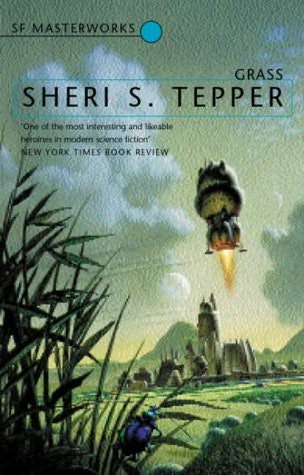
So today: Sherri S. Tepper, Grass

Let's see: Oppressive theocracy? Check. Ludicrously oversimplified sexual politics? Check? Female protagonist? Check. Deus ex Machina? Check. If you've read one SST, you've read them all.

Despite this Grass is a thoroughly satisfying read. Convincingly creepy mormon-esque future dystopia, humanity about to be wiped out by a disgusting plague, the mysterious extinction of an alien race, atavistic 'foxhunting' nobility, and miles and miles of lovingly described pampas, all come together very nicely.

So if you like your sci-fi intermingled with musings on the nature of God and humanity's role in creation, and if you've ever fancied getting it on with aliens this might be one to check out.

Tuesday, May 08, 2007

Uglies


This caught my eye the other day, as I was checking out some other stuff on Amazon (for Queenie's Kitty in fact). I'm mentally wiped out after a year of teaching so a teen trilogy sounded just the ticket.

And Scott Westerfield's Uglies series is not bad. It's not a shivers-up-your-arms classic, but it has enough solid interest to make it worth recommending to someone with young teens who might need a little self-image persepctive in their lives.

Briefly, the series (Uglies, Pretties, and Specials) follows the coming of age of Tally Youngblood, a girl who lives in a future environment where our civilization (the Rusties) imploded centuries ago from our dependance on petroleum. Humanity now lives in environmentally harmonious communities with a sophisticated bioscience industry. Most adults live and work in small suburbs. Children leave their parents to be educated up to the age of sixteen in Dorms. In their late teens early twenties they live in the City, eventually meet a partner, and settle down to the suburbs to produce the next generation, all in a sustainable, green kind of way.

The twist in the tale is all about appearance and conformity. At the age of sixteen, every citizen undergoes major cosmetic surgery. The idea is that if everybody is equally good-looking the desire and envy that subconsciously drive human relationships is eradicated. Disagreements, prejudice, discrimination, favouritism - all are done away with. Pre-Operative children are called Uglies and encouraged to disparage themselves, secure in the knowledge that on their sixteenth birthday they will become Pretty. In Pretty City they party all night and sleep all day. Not surprisingly, you can't wait to grow up.

Tally is scheduled to follow the same path as her parents and her peers, until a problem brings her to the attention of the barely-rumoured to exist Special Circumstances. Told by the Specials that she will not be allowed to turn Pretty until she finds and betrays a community of City runaways who refuse to have the operation, she is exiled into the Wild. There she discovers - surprise, surprise - that the transformation from Ugly to Pretty is a not entirely beneficial tradeoff between security and freedom.

To my jaded old eyes many of the bells and whistles features that other teens have raved about - bungee jackets, hoverboards - are the least interesting elements (but work as handy deus ex machina). Far more engaging is Tally's not always successful struggle against her conditioning and her determination to find her own way.

Friday, April 27, 2007

Hat Trick!


Thanks to the glory of iPod I've recently experienced visceral flashbacks to the 90s, courtesy of Pulp's 'Different Class'. An onlist offhand comment mentioned the possibility of 'seeing Jarvis' at an upcoming summer festival. 'Hmm,' I wonder, 'do they mean Jarvis Cocker?' And so I google and lo and behold the man has emerged from his millenial funk and produced a solo album. And quite good it seems too, from the couple of tracks I've heard.


'What next?' I hear my hipster muso friends think. 'Will she discover the wheel?'

Well, almost. I discovered Jarvcast, a podcast that has managed to score a hat trick with me through:
1) The seductively flat Sheffield tones of Jarvis Cocker
2) reading me stories
3) by Richard Brautingan!

Yes! I'm lying in bed and Jarvis Cocker in reading from The Tokyo Montana Express, one of my favoutite books of all time. Truly, the man can do no wrong.

Tuesday, February 20, 2007

Ils en ont parle


In other news, I've been reading Barbara Tuchman's 'The Proud Tower: A Portrait of the world before the War: 1890-1914'. Finally, I understand the Dreyfus affair!

And as a bonus, Wikipedia have answered one of the idle questions that have from time to time drifted across my consciousness: "Did the cartoonist Caran d'Ache take his nom de plume from the pencil brand, or vice versa?"

The answer is: the company was named after the cartoonist.